Category: Power Wheelchair
Posted by 2025-12-27 10:12
hoyer lift from floor to chair

Hoyer Lift from Floor to Chair: Safely and Dignifiedly Completing Critical Transfers After a Fall
When caring for family members or patients with limited mobility, one of the most worrying scenarios is when they accidentally fall to the floor and cannot get up on their own. This moment is not only filled with tension and helplessness, but also hides serious safety risks. If relying on manual lifting, it may not only cause low back injuries to caregivers, but also easily lead to secondary injuries to the user—such as skin tears, joint sprains, or even fractures. At this point, the Hoyer Lift transfer solution from floor to chair becomes a key tool to resolve the crisis and protect the safety of both parties.
However, not all Hoyer Lifts are suitable for direct operation from the floor. Truly effective "floor-to-chair" transfers require specialized equipment design, correct sling selection, and standardized operating procedures. This article will deeply analyze this special but crucial care scenario, helping family caregivers and professional nursing staff master scientific, safe, and dignified response methods.
Why Are Floor Transfers So Challenging?
When a person falls to a sitting or lying position on the floor, their body is at the lowest level, with almost no operating space around. Standard Hoyer Lifts are usually designed for transfers between beds, wheelchairs, or toilets, and the height of their base legs from the floor is often between 10 and 15 cm, making it impossible to place them close to the floor. This means that even if the equipment can be lowered to a relatively low position, it is difficult for the sling to be smoothly inserted under the user’s back.
In addition, floor materials (such as carpets, wooden floors) increase friction, making manual dragging difficult and dangerous. hoyer lift from floor to chair If the user cannot cooperate with turning over due to weakness, pain, or cognitive impairment, the situation becomes even more complicated. Therefore, the traditional method of "two people working together to lift" is not only inefficient, but also violates the safety principle of "replacing manual labor with machinery" in modern care.
Hoyer Lift Solutions Designed for Floor Transfers
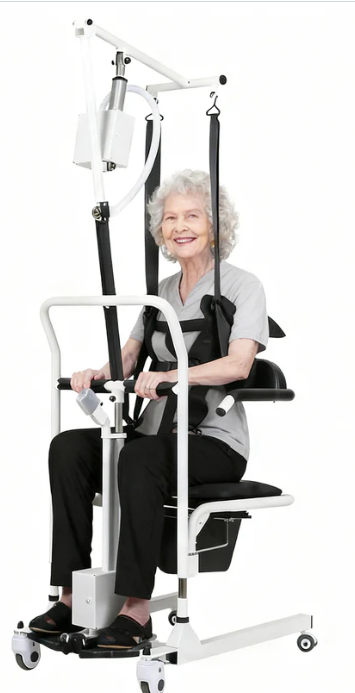
To achieve safe transfers from the floor to a chair, the key is to use a low-base or removable-leg Hoyer Lift. Through optimized structure, this type of equipment allows the main unit’s base to be almost flush with the floor, thereby creating the necessary space for inserting the sling. Some high-end models even support "Floor Mode," which can lower the boom to below 5 cm, truly realizing lifting from zero height.
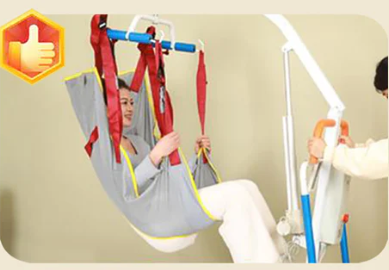
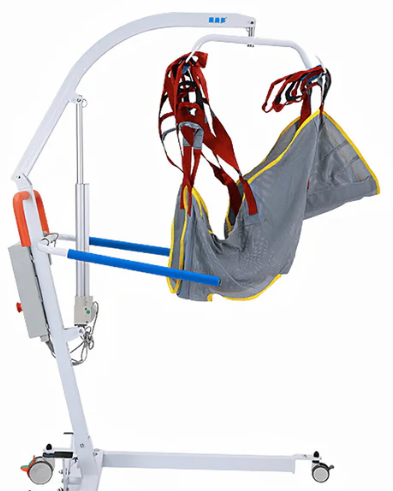
At the same time, floor-specific slings (also called rescue slings) are indispensable supporting tools. Different from ordinary full-body slings, floor slings adopt a front-opening or side-opening design, which can be worn without fully turning over the user. Their bottom is often equipped with slide rails or lifting straps for easy sliding on the floor; the material is lightweight and wear-resistant, reducing insertion resistance; some styles also have handles, facilitating multi-person collaboration to initially move the user to a hard-surface area.
For families with limited budgets or temporary emergency needs, the "slide sheet assistance method" can also be used: first use a low-friction slide sheet to move the user from a soft cushion or carpet to the edge of a hard floor, then use a standard Hoyer Lift to operate from the side. Although the efficiency is slightly lower, it is still a feasible transitional solution when specialized equipment is lacking.
Core Steps for Safe Operation
On the premise of confirming that the user has no spinal, pelvic, or lower limb fractures, the transfer can be carried out in the following steps:
First, clear obstacles around, ensure the floor is dry and level, push the target chair or wheelchair nearby, and lock the brakes. hoyer lift from floor to chair Then, extend the legs of the Hoyer Lift (or remove them to get close to the floor) and prepare the floor-specific sling.
Subsequently, while minimizing discomfort, gently assist the user to lie on their side, slide the sling under their back, adjust the position of the leg straps to ensure the back of the knees are fully supported, and fasten all connection points. When starting the lift, be sure to use the lowest speed to lift slowly, allowing the user to smoothly leave the floor by 10 to 15 cm.
After confirming stability, rotate the boom to hover directly above the chair, then lower it slowly to let the user sit gently. Finally, unfasten the sling, assist in adjusting the sitting posture, and return the equipment to its original position.
Throughout the process, keeping the boom vertical and avoiding oblique pulling is the key to preventing center-of-gravity shift; at the same time, the caregiver should observe the user’s reactions throughout and pause the operation in time to respond to discomfort.
Real Value: More Than Technology, It’s the Guardian of Dignity
The ability of Hoyer Lifts to transfer from floor to chair is more than just a technical function. It ensures that a fall no longer means the shame and helplessness of staying on the floor for a long time, and also frees caregivers from the physical dilemma of "gritting their teeth to endure hard work." In many families and elderly care institutions, equipping floor transfer equipment has become an important symbol of improving care quality.
For example, a Parkinson’s patient fell in the bedroom in the early morning. The family quickly used a low-base Hoyer Lift with a rescue sling to safely transfer him to a wheelchair within ten minutes, avoiding exposure to low temperatures and psychological panic. Another example is a community day care center that successfully achieved the safety goal of "responding within 15 minutes after a fall" by configuring a standardized floor transfer kit, and was recognized as a municipal-level demonstration unit.
Policy Support and Future Trends
Fortunately, more and more countries and regions have incorporated floor transfer equipment into their long-term care support systems. In China, multiple pilot cities for "home-based elderly care beds" provide 30% to 50% subsidies for Hoyer Lifts with floor transfer functions; in the United States, Canada, and the European Union, relevant equipment is also generally covered by Medicaid, long-term care insurance, or disabled persons’ federation funding programs.
In the future, with the development of aging-friendly technology, Hoyer Lifts will further integrate intelligent sensing, wireless remote control, and emergency alarm functions, making floor transfers more automated and humanized. But no matter how technology evolves, its core mission remains unchanged: to make every time a user gets up from the floor a safe, gentle, and dignified return.
Conclusion
Falls may be difficult to completely avoid, but the way we respond after a fall can be actively chosen by us. hoyer lift from floor to chair Equipping a Hoyer Lift suitable for floor transfers is not only a commitment to the user’s safety, but also a responsibility to the caregiver’s health. As the aging society accelerates, allowing technology to truly serve people’s needs is the real starting point of high-quality care.