Category: Power Wheelchair
Posted by 2025-12-29 11:12
hoyer lift guidelines
Hoyer Lift Guidelines: A Comprehensive Guide to Safe, Standardized, and Efficient Use of Lifting Transfer Equipment
As an indispensable assistive device in modern care for individuals with disabilities, the Hoyer Lift is widely used in homes, nursing homes, rehabilitation centers, and hospitals. It helps people with limited mobility complete critical tasks such as bed-to-wheelchair transfers, toileting, bathing, and emergency floor rescue. However, the device itself cannot automatically ensure safety—only by following scientific and systematic usage guidelines can it truly fulfill its dual role of protecting both users and caregivers.
Based on international care standards, medical device safety regulations, and clinical practice experience, this article compiles a comprehensive and practical guide for using Hoyer Lifts. It covers core aspects including equipment selection, sling matching, operating procedures, risk prevention, and maintenance, aiming to help family caregivers, nursing staff, and relevant professionals establish a standardized and human-centered transfer care system.
I. Core Preparations Before Use: Assessment and Matching
1. Assess the User’s Condition
Before each use of the Hoyer Lift, confirm the following:
Whether the user is conscious and able to follow instructions.
Whether the user has fractures, pressure sores, skin damage, or acute pain.
Whether the user’s weight, height, and mobility fall within the equipment’s load-bearing and size limits.
⚠️ If spinal injuries, pelvic fractures, or severe osteoporosis are suspected, do not use mechanical lifting. Contact medical professionals immediately.
2. Match Equipment and Slings
Load-Bearing Matching: The equipment’s rated load capacity should be ≥ the user’s weight × 1.2 (e.g., an 80 kg user requires equipment with a load capacity of ≥ 96 kg).
Sling Type Matching:
Full Body Sling: Suitable for fully dependent users.
Toileting Sling: Features a central opening for easy toileting.
Floor/Rescue Sling: Used for transfers from the floor.
Shower Sling: Made of quick-drying, mildew-resistant material.
Proper Sizing: An overly large sling may slip, while an overly small one causes discomfort due to pressure. hoyer lift guidelines Select the correct size based on the user’s height and hip circumference.
3. Inspect the Environment and Equipment Status
Ensure the floor is dry, level, and free of obstacles.
Measure door widths and furniture spacing to confirm the lift can pass smoothly.
Check if the lift legs are intact, the battery is fully charged, and the control handle is responsive.
Inspect the sling for wear, loose threads, odors, or deformation.
II. Standard Operating Procedures: The Six-Step Safe Transfer Method
Regardless of the transfer scenario (e.g., bed-to-wheelchair, floor-to-toilet), the following six principles should always be followed:
Step 1: Secure the Target Position
Move the wheelchair, bed, or toilet to the designated location, fully engage all brakes, and retract footrests or remove obstacles.
Step 2: Deploy and Stabilize the Base
Fully extend the Hoyer Lift’s legs to ensure all four base points are grounded and stable. For some models, manually lock the legs.
Step 3: Properly Apply the Sling
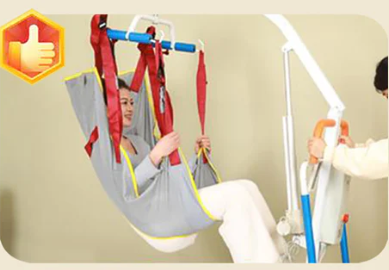
Assist the user to lie on their side.
Gently slide the sling under the user’s back to avoid dragging.
Adjust the leg straps to the middle of the thighs, avoiding the popliteal fossa (the area behind the knees).
Fasten all connecting buckles and confirm no twisting or wrinkling.
Step 4: Connect to Hooks and Pre-Lift
Accurately attach the sling’s connecting loops to the lift’s hooks, ensuring balanced weight distribution.
Start lifting slowly to raise the user 10–15 cm off the supporting surface.
Pause to check if the sling is secure and the user has no discomfort.
Step 5: Smooth Transfer and Positioning
Rotate the boom at low speed, avoiding furniture and door frames.
Hover directly above the target position, keeping the boom vertical.
Avoid oblique pulling, sudden stops, or rapid turns.
Step 6: Slow Lowering and Post-Transfer Tasks
Control the lowering speed to allow the user to sit or lie down gently.
Unfasten the sling, assist the user in adjusting their posture, hoyer lift guidelines and restore privacy (e.g., covering with a blanket, adjusting clothing).
Fold the equipment for storage and clean the sling if needed.
III. Special Precautions for High-Risk Scenarios
1. Floor Transfers
Use only low-base or detachable-leg models.
Must be paired with a dedicated floor sling.
Do not operate directly on carpets or soft mats; first move the user to a hard floor surface.
2. Operation in Narrow Bathrooms
Prioritize narrow-base or foldable models.
Temporarily remove obstacles such as trash cans and non-slip mats in advance.
Clean up water stains immediately after transfer to prevent equipment slipping.
3. Transfers for Users with High Weight or Height
Use specialized Bariatric (heavy-duty) or Tall Fit equipment.
Sling width and length need to be custom-matched.
Avoid single-person operation; two-person collaboration for monitoring is recommended.
IV. Common Mistakes and Risk Prevention
Mistake 1: Overloading
Consequence: Motor burnout, structural damage.
Prevention: Strictly select equipment based on load-bearing standards; calibrate regularly.
Mistake 2: Using Incompatible Slings
Consequence: Loose connections, center-of-gravity shifts.
Prevention: Use only original or clearly labeled compatible slings.
Mistake 3: Legs Not Fully Deployed
Consequence: Equipment tipping.
Prevention: Double-check (visually and by touch) before each use.
Mistake 4: Ignoring Sling Aging
Consequence: Sudden tearing.
Prevention: Replace slings every 6 months; hoyer lift guidelines discontinue use immediately if fraying occurs.
V. Equipment Maintenance and Lifespan Management
Daily: Check the battery, control handle, and leg locks.
Weekly: Clean the lift body, air-dry the sling, and test lifting functions.
Every 6 Months: Have hydraulic/electrical systems inspected by professionals.
Equipment Lifespan: Typically 5–7 years; for high-frequency use, evaluate retirement after 5 years.
VI. Training and Emergency Preparation
All caregivers must receive hands-on training; self-learning via videos alone is not allowed.
Post a simplified operation flowchart and emergency contact information near the equipment.
Familiarize yourself with manual emergency lowering methods (for power outages).
Establish a "fall-response-transfer" emergency plan and conduct regular drills.
Conclusion: Safety Is Not Accidental, but the Accumulation of Standards
The value of a Hoyer Lift does not lie in how advanced it is, but in whether safe guidelines are followed every time it is used. hoyer lift guidelines These guidelines may seem trivial, but they are the accumulated lessons from countless accidents. Whether you are a family caregiver or a professional nurse, always remember: standardized operation is not a burden, but the deepest respect for life.
May every transfer be smooth, and every lift be dignified—this is the true meaning of the Hoyer Lift.