Category: Power Wheelchair
Posted by 2026-01-07 10:01
hoyer lift parts
Detailed Explanation of Hoyer Lift Components: Safety Begins with Understanding Every Detail
As an indispensable patient transfer device in modern caregiving, the reliability of a Hoyer Lift stems not only from its overall design but also from the proper functioning of each individual component. hoyer lift parts From the base that supports the entire machine, to the sling that directly contacts the patient’s body, and to the core power system that controls lifting and lowering—any loosening, wear, or misuse of a single component can instantly turn a "safe transfer" into a "high-risk accident."
Therefore, whether you are a family caregiver, a nurse, or an equipment manager, you should be familiar with the main components of a Hoyer Lift and their functions. Only when you truly "understand" the equipment can you "use it correctly," "identify issues accurately," and "replace parts in a timely manner." This article will take you through the key components of a Hoyer Lift one by one, explaining their roles and maintenance key points, laying a solid foundation for every safe transfer.
Base and Legs: The First Line of Defense for Stability
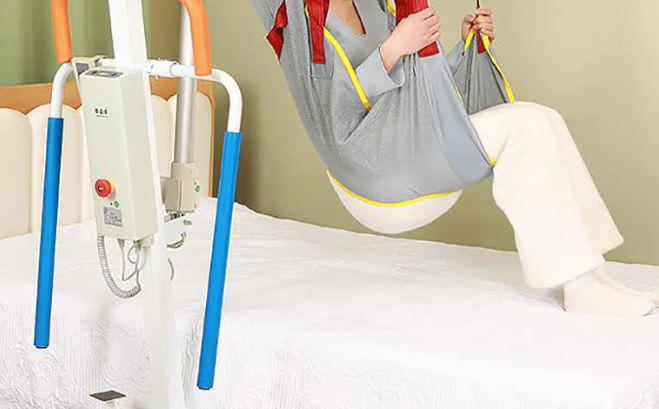
The base of a Hoyer Lift is usually U-shaped or H-shaped, made of high-strength steel or aluminum alloy, and serves as the foundation of the entire device. Four swivel casters are installed under the base for flexible movement around the room. However, the two horizontally expandable legs are the ones that truly determine stability.
Before use, the legs must be fully extended until a clear "click" sound is heard or the mechanical locking pin is seen popping out. This action may seem simple, but it is the most critical step to prevent the equipment from tipping forward. Countless accidents occur precisely because operators overlook this step in a hurry. If the legs are not locked, even the most advanced lifting system will be useless.
In addition, some high-end models are equipped with anti-slip foot pads at the ends of the legs, which are especially suitable for smooth surfaces such as tiles or wooden floors, further enhancing grip.
Lifting Arm and Hanger: The Core of Load-Bearing and Balance
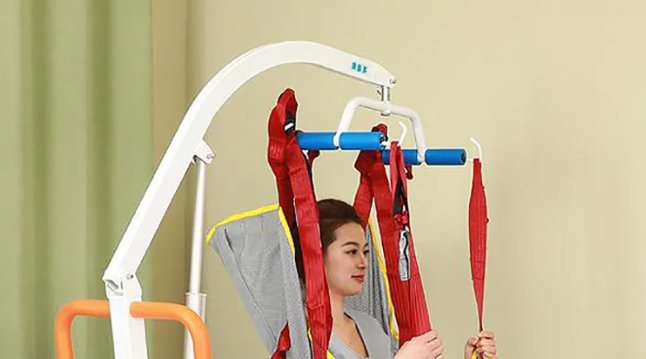
The vertical main mast contains a hydraulic cylinder or an electric push rod inside, acting as a channel for force transmission. hoyer lift parts The boom extending horizontally from the top of the mast carries the sling; its structure must be strong enough to ensure no bending or shaking under maximum load.
A rotating joint is usually installed between the boom and the mast, allowing the boom to swing left and right. This makes it easy for caregivers to accurately align the patient with a wheelchair, toilet, or shower chair. If you hear abnormal metal noises during use or notice obvious sagging of the boom, stop using the equipment immediately and contact professionals for maintenance.
Power System: Differences Between Manual and Electric Types
There are mainly two types of power sources for Hoyer Lifts: manual hydraulic systems and electric systems.
Manual models rely on caregivers repeatedly pressing a handle to push a piston upward through hydraulic oil. Their core components are the hydraulic pump and the release valve. The release valve is usually knob-style; it must be rotated counterclockwise extremely slowly to achieve a smooth descent. If it is twisted forcefully, hydraulic oil will flow back rapidly, causing the patient to fall freely—this is one of the most dangerous operational mistakes.
Electric models have a built-in rechargeable battery and motor, enabling one-button lifting and lowering via a remote control or control panel. They are not only labor-saving but also equipped with an emergency stop button (usually bright red), which can immediately cut off the power supply in emergency situations to prevent out-of-control. However, the electric system needs to be charged regularly, and attention should be paid to battery life (usually 2–3 years) to avoid interrupting the transfer due to exhausted power.
Sling: The Lifeline Directly Related to Patient Safety
If a Hoyer Lift is compared to a skeleton, then the sling is its flesh and blood—it directly wraps around and supports the patient’s body. hoyer lift parts Slings are usually made of high-strength polyester fiber or nylon fabric, and are divided into full-body type, toileting type, mesh bathing type, etc., according to their uses.
Both ends of the sling are equipped with multiple lifting rings or quick-release buckles for connecting to the hooks of the lifting arm. Although these connectors are small, they bear the entire weight of the patient, so it is necessary to ensure there are no cracks, no deformation, and the closure is firm.
Most importantly, slings are consumables. Even if they look intact, the fibers will fatigue and age after long-term use. Any thread fraying, mildew spots, peculiar smells, or cracked seams are signals to stop using the sling immediately. Manufacturers and regulatory authorities consistently emphasize: it is better to replace a sling one more time than to take the risk of it breaking once.
Casters and Brakes: Safety Guarantees During Movement
The four swivel casters allow the Hoyer Lift to turn flexibly in the room. High-quality casters are made of polyurethane, which is quiet, wear-resistant, and does not scratch the floor. The foot brakes ensure that the equipment does not slide accidentally during the transfer process. Some models adopt a central linkage design, allowing all casters to be locked with one step, improving operational efficiency.
In daily use, you should regularly check whether the casters are loose, whether they rotate smoothly, and whether the brakes are effective. A stuck caster may cause the equipment to shift, making the patient lose balance in mid-air.
Safety Auxiliary Accessories: Invisible Guardians
In addition to the main structure, many modern Hoyer Lifts are also equipped with practical safety accessories. For example, a battery level indicator can give an early warning of insufficient power; a sling storage bag facilitates storage after cleaning to avoid contamination; and an automatic leg sensing device can prevent the lift from starting if the legs are not fully extended, forcing operators to follow safety procedures.
These details may seem small, but they reflect the design concept of "safety as the core."
Conclusion: Respecting Tools Means Respecting Life
Understanding every component of a Hoyer Lift is not just for maintenance or replacement, but more importantly, to establish a sense of awe for the tool. hoyer lift parts When you squat down to check if the legs are locked, when you touch the sling to confirm there is no damage, and when you slowly rotate the release valve—what you are doing is not just operating a machine, but fulfilling a commitment to life.
Because true safety is never accidental; it is jointly built by countless carefully treated details. On the road of caregiving, may we all be able to: understand its structure, clarify its principles, abide by its rules, and protect those in need.