Category: power lift chairs
Posted by 2025-12-29 11:12
hoyer lift hcpcs code
Hoyer Lift HCPCS Codes: Correct Coding Is the Key to Securing Medicare and Insurance Reimbursement
When applying for reimbursement for a Hoyer Lift from Medicare, Medicaid, or commercial health insurance, HCPCS codes (Healthcare Common Procedure Coding System) are an indispensable component. These seemingly simple alphanumeric combinations are essentially the "passport" that determines whether medical equipment can be recognized, reviewed, and reimbursed by insurance companies. Choosing the wrong code or using it incorrectly can lead to delays in reimbursement at best, or outright denial at worst.
This article will clearly explain the commonly used HCPCS codes related to Hoyer Lifts, their applicable conditions, common misunderstandings, and application recommendations. It aims to help patients, caregivers, and DME (Durable Medical Equipment) suppliers accurately match equipment with codes, thereby increasing the success rate of reimbursement claims.
What Are HCPCS Codes?
HCPCS is a standard coding system developed by the U.S. Centers for Medicare & Medicaid Services (CMS) to uniformly identify medical services, supplies, hoyer lift hcpcs code and equipment. Among its code categories, L-codes and E-codes are frequently used for rehabilitation aids and transfer equipment:
L-codes: Primarily used for orthotics, prosthetics, and certain supportive devices.
E-codes: Specifically designated for Durable Medical Equipment (DME), including wheelchairs, hospital beds, and lifts.
Hoyer Lifts and their accessories mainly use codes from the E-series.
Detailed Explanation of Common HCPCS Codes for Hoyer Lifts
1. E0630 – Hydraulic Lift, Manual
This is the most basic and widely used HCPCS code for Hoyer Lifts, applicable to:
Hydraulic models that rely on repeated manual handle pumping to lift and lower.
Typically mobile units with a leg-based base.
A weight capacity usually ranging from 350–400 pounds (approximately 159–181 kilograms).
Applicable Scenarios: Low-to-moderate frequency use in home care settings, situations where caregivers have sufficient physical strength, or when budget is a constraint.
Medicare Coverage: If medical necessity is demonstrated, approval is generally easier to obtain, and reimbursement is often provided for outright purchase (rather than rental).
2. E0635 – Electric Lift
Applicable to:
Fully or semi-electric models where lifting/lowering is powered by electricity.
Features include battery power, handle controls, and quiet motors.
Typically support smoother operation and higher weight capacities.
Applicable Scenarios: High-frequency transfers, situations where caregivers are elderly or have limited physical strength, or when quiet operation (e.g., nighttime use) is required.
Medicare Coverage: Stronger medical justification is required (e.g., the caregiver is unable to operate a manual lift). hoyer lift hcpcs code Coverage is usually provided through rental; after 13 months of rental, ownership of the equipment typically transfers to the patient.
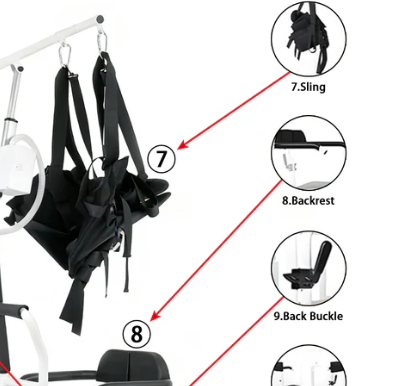
3. E0639 – Sling for Use with Patient Lift
This code applies to slings that are used with Hoyer Lifts, including:
Full Body Slings
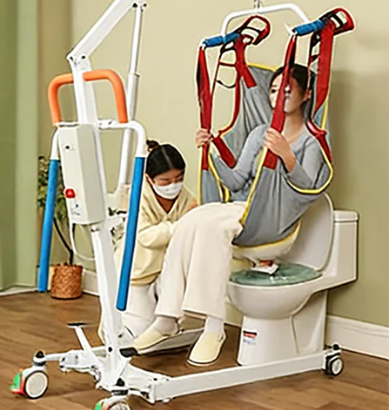
Toileting Slings
Floor/Rescue Slings
Shower Slings
Note: E0639 is a general code for slings and does not distinguish between types or sizes. However, when submitting a reimbursement claim, the specific purpose of the sling (e.g., "for toileting transfers") must still be documented in medical records to demonstrate its necessity.
How to Select the Correct HCPCS Code?
Choosing the right code depends not just on the equipment’s appearance, but on its functionality, power source, and intended use scenario:
If your Hoyer Lift relies entirely on manual handle pumping to lift, use E0630.
If the lift’s raising/lowering function is powered by a battery or electricity (even if the base requires manual adjustment), it falls under E0635.
All accompanying slings use E0639 uniformly, but ensure compatibility with the main lift unit.
Example of a Common Mistake: Misclassifying a "semi-electric" lift (with electric lifting but manual base adjustment) as E0630 may result in claim denial due to "code mismatch." In reality, any lift where the lifting action is electrically powered should be coded as E0635.
The Relationship Between HCPCS Codes and Medicare Reimbursement
When reviewing DME reimbursement claims, Medicare strictly verifies whether the HCPCS code aligns with the prescription, medical records, and the actual functionality of the equipment. For example:
If a doctor’s prescription specifies "electric lift required for transfers," but the supplier bills using E0630 (manual lift), the claim may be denied.
When billing for a sling using E0639, the claim may be rejected as "unattached supplies" if there is no prior reimbursement record for the corresponding lift unit (E0630/E0635).
Additionally, starting in 2024, some states have implemented a Prior Authorization system for high-cost DME like E0635. hoyer lift hcpcs code This requires submission of the HCPCS code, prescription, and functional assessment before equipment delivery; otherwise, payment will not be approved.
Considerations for Suppliers, Patients, and Caregivers
For DME Suppliers:
Ensure the equipment provided exactly matches the HCPCS code used for billing.
Retain equipment technical specification documents for audit purposes.
Use the official CMS-approved code version (updated annually).
For Patients and Family Members:
Before purchasing or renting, confirm the HCPCS code to be used with the supplier.
Verify that the code on invoices and reimbursement forms matches the one in the doctor’s prescription.
If a claim is denied, request the supplier to provide the basis for code selection and cooperate in the appeal process.
Special Cases: Floor Transfers and Bariatric Models
Currently, the HCPCS system does not have separate codes for "low-base" or "floor-specific" Hoyer Lifts. hoyer lift hcpcs code Regardless of whether a lift supports floor transfer mode, as long as the power source is the same, E0630 or E0635 still applies. Therefore, when applying for reimbursement, it is necessary to explicitly state "floor transfer functionality required" in medical documents and have a therapist issue an assessment report to strengthen the case for medical necessity.
Similarly, bariatric (heavy-duty) Hoyer Lift models with a weight capacity exceeding 400 pounds also use the same codes (E0630/E0635). However, the patient’s weight and specific needs must be noted in the prescription.
Conclusion: Small Codes, Big Impact
Although HCPCS codes are only five characters long, they carry triple significance—validating the equipment’s legality, justifying its medical need, and ensuring financial feasibility. For high-value DME like Hoyer Lifts, the correct use of E0630, E0635, and E0639 is not just a technical detail, but a critical step in securing successful reimbursement.
Whether you are a patient, family member, or DME supplier, it is essential to prioritize the accuracy of HCPCS codes and treat them as an indispensable part of the care chain. Only by doing so can advanced assistive equipment truly benefit those in need, without being hindered by a simple code discrepancy at the billing stage.