Category: power lift chairs
Posted by 2025-12-30 11:12
hoyer lift in use
Hoyer Lift in Use: Balancing Safety, Dignity, and Efficiency in Real-World Care Scenarios
The Hoyer Lift has long transcended the category of a "medical device" to become a vital link connecting safety, dignity, and humanistic care in modern care systems. Whether in hospital wards, rehabilitation centers, or the bedrooms and bathrooms of ordinary homes, when used correctly, every smooth lift and lower is more than just a physical transfer—it is a gentle embrace that upholds the dignity of life.
However, the true value of a Hoyer Lift does not lie in its metal structure or electric motor, but in how it is used: whether operations are standardized, whether the sling is properly matched, whether communication is sufficient, and whether the environment is well-prepared. This article focuses on the "in use" state of the Hoyer Lift, exploring how this device truly empowers care in practice—from daily scenarios and operational details to humanistic care.
I. Typical Usage Scenarios of the Hoyer Lift
Home: A Bridge from Dependence to Independence
At 6 a.m., an elderly man with post-stroke hemiplegia needs to be transferred from his bed to a wheelchair for breakfast. His wife, nearly 70 years old, can no longer bend down to lift him as she once did. Now, she simply extends the Hoyer Lift’s legs, fastens a full-body sling around her husband, and presses a button on the control handle—completing the transfer in just a few minutes. The entire process is quiet and smooth: the elderly man does not have to expose his body for long, and his wife no longer spends the whole day in bed due to back pain. This machine transforms care from a "physical endurance battle" into "collaborative support."
Hospital: Dual Assurance of Safety and Efficiency
In a neurology ward, a patient in the advanced stages of Parkinson’s disease cannot stand at all. Working in pairs, nurses use a fully electric Hoyer Lift with a toileting sling to transfer the patient to the toilet without disconnecting their urinary catheter. The entire process takes less than five minutes: the patient’s privacy is protected, caregivers avoid occupational back injuries, and the care rhythm of the ward becomes much smoother as a result.
Elderly Care Facilities: The Cornerstone of Standardized Care
A high-end elderly care community provides each severely disabled resident with a dedicated sling, color-coded by purpose (green for daily transfers, blue for bathing, red for isolation use). All caregivers must pass a Hoyer Lift operation assessment before taking up their posts. This institutionalized management has significantly reduced the rate of falls and skin injuries, and has become a key reason for families to choose this facility.
II. Five Core Elements of Correct Usage
1. Pre-Use Assessment: Not Suitable for All Situations
The Hoyer Lift is not a one-size-fits-all solution. For patients with unstable fractures, severe osteoporosis, hoyer lift in use open wounds, or increased intracranial pressure, mechanical lifting may pose risks. Before use, a nurse or therapist should conduct a quick assessment to confirm there are no contraindications.
2. Sling Matching: Details Determine Safety
The sling is the part that directly contacts the patient’s body, so its type, size, and condition are crucial:
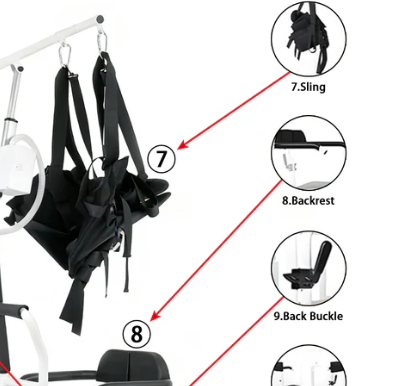
Full-body slings are for patients with complete dependence.
Toileting slings have a central opening for easy access to the toilet.
Floor rescue slings are specifically designed for lifting patients from the ground.
Slings that are too large may slip; those that are too small can compress blood vessels and nerves.
Before each use, the sling must be checked for wear, loose threads, odors, or mold.
3. Environmental Preparation: Space and Privacy Are Equally Important
Clear obstacles (wires, slippers, pets) along the transfer path.
Ensure the floor is dry and non-slip.
Draw curtains or use room dividers to minimize body exposure time.
Inform the patient of the upcoming procedure in advance to ease anxiety.
4. Operational Standards: Slow Is Fast
Legs must be fully extended and locked.
For the first lift, raise only a few centimeters to test stability.
Maintain a constant speed during lifting/lowering; avoid sudden stops or shaking.
After the transfer, confirm the patient is seated securely before removing the sling.
5. Post-Use Tidy-Up: Closing the Care Loop
Help the patient adjust their clothing and cover them with a blanket.
Clean the sling (if washable) or return it for disinfection.
Record equipment usage to facilitate maintenance tracking.
III. Beyond Technology: Integrating Humanistic Care
Using a Hoyer Lift is not just a technical task—it is an opportunity for emotional communication. Experienced caregivers know:
To speak softly before operation: "We’re going to move to a new spot now. Just relax, I’ll hold onto you."
To ask during the transfer: "Is this comfortable? Does anything feel too tight?"
To adjust the patient’s pillow and hand them a cup of warm water after completion.
These small gestures fill the cold mechanical process with warmth. hoyer lift in use As a spinal cord injury patient who has used a Hoyer Lift long-term said: "I’m not afraid of being lifted by a machine. What I’m afraid of is being treated like an object. But when I hear, ‘Are you ready?’, I know I’m still being treated like a person."
IV. Common Misconceptions and Areas for Improvement
Misconception 1: "With a machine, we don’t need people anymore."
→ Fact: A Hoyer Lift still requires at least one operator; two people are recommended for high-risk transfers.
Misconception 2: "One sling works for all situations."
→ Fact: Specialized slings are needed for different scenarios; mixing slings can easily cause infection or discomfort.
Misconception 3: "You can use it right after buying it."
→ Fact: Operating without training carries high risks; professional guidance is recommended for first use.
In the future, with the development of intelligent sensors, voice control, and IoT technology, Hoyer Lifts will become safer and easier to use. hoyer lift in use But no matter how technology advances, the core of care remains people—understanding, respecting, and being responsible for others.
Conclusion: Realizing Value Through Use
The true significance of a Hoyer Lift is not in storage or in its packaging, but in every moment it is used correctly, gently, and with dignity. hoyer lift in use It is not a tool to replace caregivers, but an extension of their capabilities; not cold steel, but a carrier of care.
When we see an elderly person safely transferred from bed to a window to enjoy the sun, a nurse smiling as she rubs her no-longer-sore waist after completing a night shift transfer, or a family regaining peace because they no longer fear "not being able to lift"—that is when the Hoyer Lift truly fulfills its mission.