Category: Electric Transfer Chair
Posted by 2025-12-20 11:12
hoyer lift for dementia patients
Safe Transfer for Dementia Patients: A Comprehensive Guide to Using Hoyer Lifts
Caring for dementia patients is a task filled with love and challenges. Among daily care routines, safely transferring patients from beds to wheelchairs or toilets is one of the most common yet high-risk tasks. Dementia patients often experience declining physical functions, stiff limbs, or non-cooperation. Manual lifting can easily cause back injuries to caregivers and lead to patients falling or fracturing bones. In such cases, Hoyer Lifts become a revolutionary tool to ensure the safety of both parties.
I. Why Do Dementia Patients Specifically Need Hoyer Lifts?
Ensure Safety and Prevent Falls
Dementia patients may have balance disorders and impaired judgment. During transfers, sudden movements, non-cooperation, or attempts to stand up independently can easily result in falls, leading to severe injuries like hip fractures. Hoyer Lifts can lift and move patients steadily, fundamentally eliminating the risk of falls.
Reduce Caregiver Burden
Manually lifting or supporting an adult places a huge burden on the caregiver’s lower back. Using mechanical equipment can prevent occupational injuries such as muscle strains and herniated discs in caregivers, making care work more sustainable.
Address Behavioral and Psychological Symptoms of Dementia (BPSD)
When patients become agitated, resistant, or fail to understand instructions, manual transfers may be perceived as a threat, triggering aggressive or fearful behaviors. Hoyer Lifts provide a smoother, less intrusive transfer method, which can sometimes soothe patients’ emotions.
Maintain Patient Dignity
A smooth and steady transfer process better preserves the patient’s dignity compared to strenuous manual lifting that may involve pulling or dragging. Standardized operations help patients feel safe rather than embarrassed.
II. How to Choose the Right Hoyer Lift for Dementia Patients?
There are various types of lifts available on the market. When choosing one for dementia patients, consider the following factors:
Sling Type (This is Critical!)
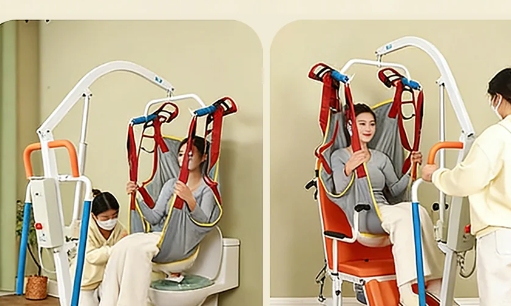
Full-body slings: Provide full-body support, suitable for patients who cannot stand at all or have extremely low cooperation.
Stand-up slings: Require patients to have partial leg support ability. For some early or mid-stage dementia patients who can understand simple instructions, stand-up lifts can encourage their participation in the transfer process, helping to maintain remaining physical functions.
Material
Choose soft, breathable, and easy-to-clean materials to enhance comfort.
Lift Drive Type
Hydraulic lifts: Operate smoothly and are more affordable, but require a certain amount of physical strength to press the lever.
Electric lifts: Only need to press a button to lift or lower, which is very labor-saving. They are especially suitable for caregivers with limited strength or patients with heavier body weights. The quiet operation of electric models also helps avoid startling patients sensitive to sounds.
Body Design and Functions
Base width: Choose models with adjustable bases to ensure they can easily fit under furniture such as beds and chairs.
Swivel casters and brakes: Flexible swivel casters facilitate steering, and a stable brake system ensures safety.
Overall weight and storage: Consider the storage space available at home.
III. Standard Operating Procedures for Using Hoyer Lifts (Especially for Dementia Patients)
Step 1: Preparation - Communication and Environment
Explain and soothe: Use a simple, calm tone to tell the patient what will happen next. Even if he/she may not fully understand, your voice and attitude can convey a sense of security. You could say, “Grandma, we will use this safe strap to help you sit in the chair and look out the window now.”
Check the equipment: Ensure all parts of the lift are in good condition, the battery is fully charged (for electric models), and the sling is clean and undamaged.
Clear the area: Remove obstacles along the transfer path and ensure the floor is dry and non-slip.
Engage the brakes: Fully lock the lift’s wheels.
Step 2: Position the Patient and Sling
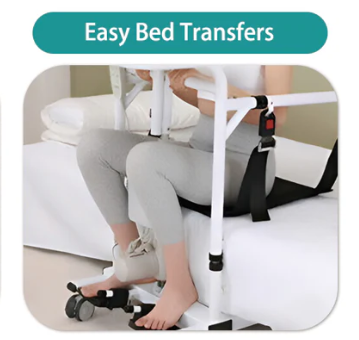
Move the lift to the bedside and extend its legs under the bed.
Assist the patient to lie on their side, then spread the sling flat on the bed with its centerline aligned with the patient’s spine.
Help the patient lie flat again, ensuring the sling is placed smoothly under their body without wrinkles.
Connect the shoulder straps or buckles of the sling to the lift’s boom.
Step 3: Perform the Transfer
Recheck: Confirm all connections are secure and the patient’s limbs are not pinched.
Lift steadily: Operate the lift slowly to lift the patient a short distance off the bed. Pause to observe the patient’s reaction and ensure he/she feels comfortable and safe.
Move: Release the brakes, then push the lift and patient steadily away from the bed and turn toward the target location (e.g., a wheelchair).
Lower steadily: Move the patient above the target seat, then lower him/her slowly and steadily until they are fully seated.
Disconnect: First unfasten the buckle on your side, then assist the patient to slightly roll onto their side to unfasten the buckle on the other side. Finally, gently pull the sling out from under the patient.
IV. Special Precautions and Tips for Dementia Patients
Turn transfers into a routine: Conduct transfers at fixed times and in a similar manner every day to reduce the patient’s confusion and resistance.
Use distraction techniques: During the transfer, play soft music the patient likes or let him/her hold a familiar comfort item (e.g., a soft doll, a small blanket).
Maintain eye contact and touch: While operating, maintain eye contact with the patient, and use gentle touches (e.g., patting the arm) along with smiles and encouraging words to soothe him/her.
Never force the operation: If the patient shows extreme fear or violent resistance, pause the operation. Forcing it will intensify their psychological trauma and may lead to danger. Wait for a moment until he/she calms down before trying again, or seek help from other caregivers.
Caregiver training is crucial: Before using the lift for the first time, be sure to receive training from professional medical staff or equipment suppliers. Correct operation is the core of safety.
V. Common Misconceptions and Taboos
Misconception 1: “Only bedridden patients need it.”
Correct Answer: For dementia patients who have unstable standing or are prone to falling, using stand-up or full-body slings at an early stage is a safer choice.
Misconception 2: “With the machine, the patient will never use their own strength again.”
Correct Answer: Under the guidance of therapists, Hoyer Lifts can be used to assist patients in rehabilitation training, encouraging them to use their remaining muscle strength in a safe environment.
Taboos
Using the lift without training.
Continuing to use slings or connectors that are worn out.
Transferring patients on slopes or uneven ground.
Keeping the patient suspended in the air for too long during transfers.
Conclusion
Hoyer Lifts are not just cold machines. For dementia patients and their caregivers, they are guardians of safety, dignity, and sustainable care. Investing in and learning to use this tool correctly can significantly improve the quality of care, protect the physical and mental health of caregivers, and make this challenging journey more stable and enduring.
Would you like me to organize this English translation into a formatted document with a clear table of contents? This will make it easier for you to quickly locate specific sections like operating steps or precautions when using it.