Category: Patient Lifts
Posted by 2025-12-31 10:12
hoyer lift jacket
Detailed Explanation of Hoyer Lift "Jacket" Slings: A Key Accessory for Safe Patient Transfers
When using a Hoyer Lift for patient transfers, aside from the lift unit itself, the sling is the core component that directly contacts the user’s body and bears their full weight. Among the various types of slings, one design often referred to by users as a "Hoyer Lift Jacket" is particularly popular among specific groups due to its unique wraparound structure and stability.
However, "Jacket" is not an official medical term but a vivid colloquial name. This article will clarify this concept, detail its structure, suitable user groups, usage methods, and precautions, helping caregivers select and use such slings correctly and safely to avoid injuries caused by misunderstanding or improper use.
What Is a "Hoyer Lift Jacket"?
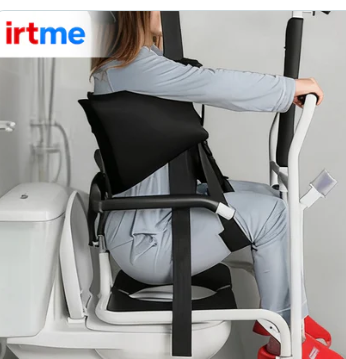
A "Hoyer Lift Jacket" typically refers to a full-body sling with sleeves or an upper-body wrapping design, resembling a buttonless jacket or vest. By covering the user’s shoulders, back, and part of the chest, it provides stronger trunk support than traditional U-shaped or mesh slings. It is especially suitable for patients who cannot independently maintain a sitting position, have low muscle tone, or tend to lean forward.
Despite the term "Jacket" in its name, it is not daily clothing but a medical-grade sling specifically designed for mechanical lifting. It is made of high-strength polyester, nylon, or waterproof and antibacterial materials, equipped with multiple lifting loops and quick-release buckles.
✅ Correct Terminology: Full-Body Sling with Torso Support or Amputee/High-Support Sling❌ Informal Names: "Jacket sling", "Vest sling", "Hoyer jacket"
Structural Features and Advantages
1. Upper-Body Wrapping Design
Padded sleeves or wide straps on the shoulders to prevent slipping
Full back support to distribute pressure and reduce skin shear
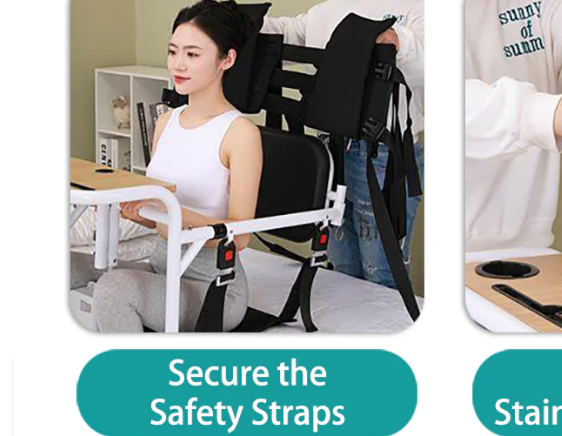
Cross straps or adjustable buckles on the chest to prevent forward leaning
2. Enhanced Stability
For patients with advanced Parkinson’s disease, severe cerebral palsy, spinal cord injuries, or age-related frailty, ordinary slings may cause the head to droop forward or the body to slide sideways during lifting. The "Jacket"-style design effectively maintains a neutral body position, ensuring a smoother lifting process.
3. Suitable for Special Body Types
Amputee patients (with shifted center of gravity)
Extremely emaciated patients (with prominent bones requiring extra cushioning)
Patients with complete loss of trunk control
Typical Application Scenarios
Transfer from bed to wheelchair: For patients who cannot support themselves with their hands and require full trunk stabilization throughout the process
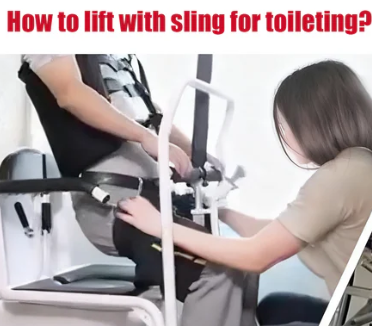
Toileting assistance: When used with a "Jacket" variant featuring a crotch opening, toileting can be completed without removing the sling
Transition to standing frames during rehabilitation training: Provides additional upper-body support
Patients with cognitive impairments: Due to their inability to follow instructions, higher wraparound support is needed to prevent slipping during struggles
⚠️ Note: Not all "Jacket" slings are suitable for toileting! Always confirm if it is a "Toileting Version" (with a central opening); otherwise, the sling must be replaced midway, increasing risks.
How to Correctly Use a "Jacket"-Style Sling?
Step 1: Choose the Appropriate Size
Slings are usually graded by height and weight (S/M/L/XL). Oversized slings may slip, while undersized ones can compress the chest and affect breathing. Measuring the chest and hip circumferences is crucial.
Step 2: Assist with Donning
Help the patient lie on their side
Slide the folded sling under the patient’s back, aligning the sleeves with their arms
Once the patient lies flat, guide their arms into the sleeves (if sleeve-equipped)
Fasten the chest buckles and adjust the tightness (allowing two fingers to fit between the sling and the patient’s body)
Ensure the lower edge of the sling fully covers the ischial tuberosities
Step 3: Connect and Lift
Attach all 4 lifting loops of the sling to the lift’s hooks
Perform a low-level test (5 cm off the ground) to confirm no slipping or pressure points
Lift and transfer the patient slowly
[Diagram: Correct Donning of a Jacket Sling — Full coverage of shoulders and back, secure chest fastening, and complete hip support]
Common Misconceptions and Risks
❌ Misconception 1: "The Tighter the Wrapping, the Safer"
→ Over-tightening restricts breathing and compresses subclavian blood vessels, posing risks especially to patients with COPD or heart failure.
❌ Misconception 2: Using It on Areas with Skin Damage
→ If the patient has pressure sores or post-surgical wounds on the back, a backless sling or custom pressure-relief model should be used instead.
❌ Misconception 3: Repeated Long-Term Use Without Cleaning
→ "Jacket"-style slings have a large contact area and are prone to bacterial growth. Inspect them after each use, clean them weekly (if material allows), and replace them every 6–12 months mandatorily.
How to Purchase and Maintain?
Certification Check: Choose medical-grade slings that meet the ISO 10535 standard
Brand Compatibility: Mainstream Hoyer Lift manufacturers such as Arjo, Stryker, and Invacare all offer matching "Jacket" slings. Interfaces are universal, but sizes may vary slightly
Material Selection:
Daily use: Breathable mesh fabric
Bathing/incontinence: Waterproof PVC or quick-dry materials
Sensitive skin: Dye-free, seamless-edge designs
Conclusion: Small Sling, Great Responsibility
The high-support sling known as the "Hoyer Lift Jacket" serves as a "second skin" for safe transfers among many patients with severe dependence. It not only bears weight but also upholds dignity and trust. Correct selection, standardized operation, and regular maintenance are the responsibilities of every caregiver.
Remember: No matter how advanced the lift is, it cannot compensate for an incorrectly used sling. Taking the time to understand your sling type adds an extra layer of safety for your loved ones.