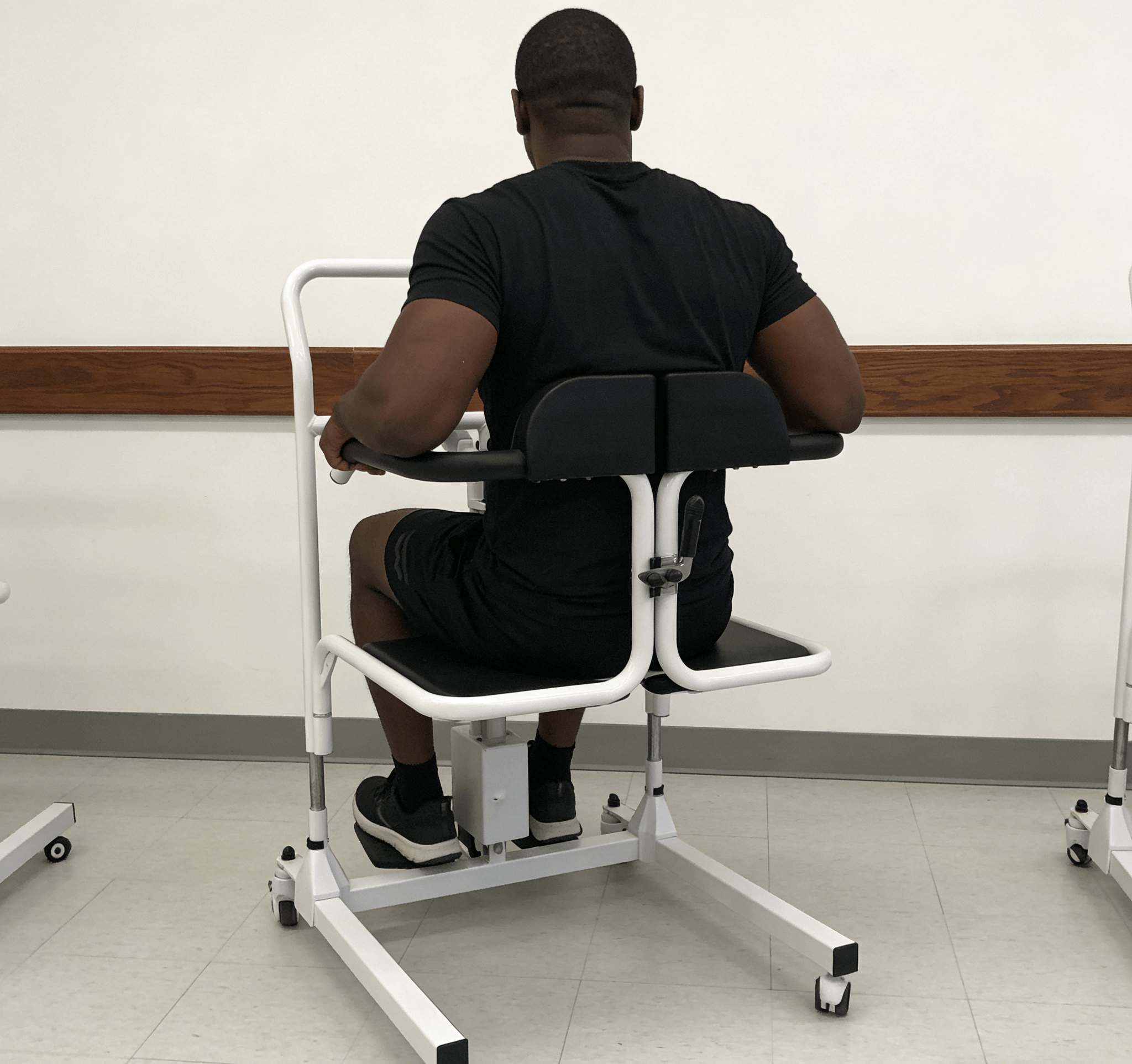
Category: Electric Transfer Chair
Posted by 2025-12-11 11:12
hoyer lift and hospital bed
Hoyer Lift and Hospital Bed: Building the Golden Combination for Safe Transfers
In long-term care scenarios, the hospital bed serves as the core platform for patients' rest and recovery, while the Hoyer Lift acts as a crucial bridge connecting the bed to other living spaces (such as wheelchairs, toilets, and bathrooms). When these two pieces of equipment are scientifically matched and reasonably arranged, they not only significantly improve care efficiency but also fundamentally prevent the risk of caregivers suffering from low back injuries and patients falling.
However, many families only focus on purchasing a single piece of equipment, ignoring the spatial compatibility, functional synergy, and operational smoothness between the two. This leads to issues such as the Hoyer Lift being unable to slide under the bed smoothly, stuck transfer processes, and in some cases, the lift even being abandoned.
This article will detail how to achieve true "seamless coordination" between the Hoyer Lift and the hospital bed, creating a safe, efficient, and humanized home care environment.
I. Why Must We Consider Their Synergy?
The hospital bed provides posture adjustment, fall prevention protection, and comfortable support; the Hoyer Lift enables transfer without manual lifting. Yet, if their designs are incompatible, problems may arise, including:
Insufficient ground clearance under the hospital bed, making it impossible for the Hoyer Lift’s base to slide in;
Crossbeams of the bed frame blocking the sling from sliding underneath the patient;
Side rails that are too high or non-removable, hindering the wearing of the sling;
Transfer paths blocked by bedside tables, wires, and other obstacles.
These issues can render expensive Hoyer Lifts useless "decorations," forcing caregivers to return to high-risk manual lifting.
II. Key Compatibility Factors for Hospital Beds
To ensure the smooth use of the Hoyer Lift, the hospital bed must meet the following requirements:
1. Sufficient Under-Bed Clearance
The height of a typical Hoyer Lift base ranges from 8 to 12 cm;
The minimum ground clearance of the hospital bed should be ≥ 10 cm (ideally 12–15 cm);
Avoid "home-style" care beds with closed storage drawers or thick bottom panels.
2. Open Bed Frame Structure
The bottom of the bed should be free of horizontal metal rods or dense supports, as these will block the sling from sliding under the patient;
"H-shaped" or "U-shaped" open underframe designs are recommended, as they facilitate the sling sliding under the patient.
3. Removable or Foldable Side Rails
One side rail must be temporarily removed during transfer to allow caregivers to approach the patient and place the sling;
Fixed side rails will severely hinder operations and increase the risk of falls.
4. Adjustable Bed Height to Low Position
Fully electric hospital beds should have an "ultra-low bed surface" mode (≤ 38 cm) to facilitate the insertion of the sling;
If the bed surface is too high, additional padding for the Hoyer Lift base will be required, which affects stability.
III. Selection Points for Hoyer Lifts (for Hospital Bed Environments)
1. Base Type Matching the Space
Standard base: Suitable for spacious bedrooms, offering the best stability;
Narrow/scissor base (Sliding Leg or Narrow Base): Designed specifically for narrow spaces, can slide under most hospital beds;
Ceiling track lift: No floor base required, but requires house modification, suitable for long-term fixed use.
✅ Home Preference: Electric or hydraulic Hoyer Lifts with narrow bases, balancing flexibility and load-bearing capacity.
2. Sufficient Boom Height
When raised, the bottom of the boom should be higher than the maximum height of the hospital bed (usually ≥ 130 cm) to ensure the patient can be completely lifted off the bed.
3. Quiet Operation and Smoothness
A low-noise motor is required for operation in patient rooms to avoid disturbing the patient;
The lifting and lowering process should be smooth to prevent discomfort caused by sudden starts.
IV. Standard Transfer Operation Process (Bed → Wheelchair)
Preparation Phase
Lower the hospital bed to its lowest position and remove the side rail on the side close to the wheelchair;
Clear obstacles around the bed to ensure an unobstructed path for the Hoyer Lift;
Place the wheelchair at a 90° angle to the bed and lock its wheels.
Sling Wearing
Assist the patient to lie flat, slide the folded sling under the patient from behind, and adjust it to be under the hips and thighs;
Fasten all buckles and ensure there is no twisting.
Inserting the Hoyer Lift
Push the Hoyer Lift base under the bed and extend the support legs (if applicable);
Attach the four corners of the sling to the lift’s hooks.
Lifting and Transferring
Slowly lift the patient 10–15 cm off the bed;
Use the control handle to move the patient horizontally above the wheelchair;
Lower the patient smoothly, assist them to sit firmly, and then unbuckle the sling.
Resetting
Retract the Hoyer Lift, reattach the side rail, and raise the hospital bed to a comfortable position.
V. Common Mistakes and Risk Avoidance
❌ Attempting to insert the Hoyer Lift when the hospital bed is in a high position→ The bed must be lowered to its lowest position first; otherwise, the base cannot slide in.
❌ Using a "home care bed" with a closed bottom panel→ Such beds may look aesthetically pleasing, but they are completely incompatible with Hoyer Lifts. Always confirm the under-bed structure before purchasing.
❌ Ignoring interference from wires and sensors→ The hospital bed’s power cord and bed-exit alarm pad wires should be fixed at the foot of the bed to avoid tangling with the Hoyer Lift’s wheels.
❌ Single-person operation for complex transfers→ For patients who are overweight or restless, two-person collaboration is recommended: one person operates the equipment, and the other stabilizes the patient.
VI. Space Planning Recommendations (Home Scenarios)
Reserve a width of at least 90 cm beside the bed: For the Hoyer Lift base to enter and exit;
Leave a depth of 120 cm at the foot of the bed: To facilitate turning and wheelchair docking;
Avoid overly thick carpets: These affect the movement of the Hoyer Lift. Hard floors or thin carpets are recommended;
Install power outlets near the head of the bed: To reduce wires running across the floor.
VII. Special Reminder: The Importance of Rental and Trial
Many medical equipment companies offer rental packages of "hospital bed + Hoyer Lift," allowing a 1–2 week trial;
Before finalizing the purchase, be sure to test the compatibility between the Hoyer Lift and the hospital bed with the actual equipment;
Community elderly care service centers or hospital social workers can assist in evaluating the home layout.
Conclusion
A hospital bed,Bears the peace of rest and recovery;A Hoyer Lift,Connects to the possibilities of daily life.
When the two work in scientific synergy,Care is no longer a laborious task of carrying heavy loads,But a well-organized act of guardianship.
Genuine safe care,Begins with respect for details,And succeeds through systematic thinking.
May every family,Through reasonable equipment matching and space planning,Allow love to be,With less risk,And more ease.