Category: Patient Lifts
Posted by 2026-01-06 10:01
hoyer lift one person assist
Solo-Assisted Operation of Hoyer Lifts: Safe and Feasible, but Strict Adherence to Standards Is Required
In home care settings or nursing environments with staffing shortages, a common yet critical question arises: "Can a Hoyer Lift be operated by one person?" The answer is yes, but with prerequisites. One of the design intentions behind modern Hoyer Lifts (especially electric models) is to support safe solo operation, thereby reducing the care burden and improving efficiency. However, " hoyer lift one person assist being operable by one person" by no means equates to "operating arbitrarily"—it requires appropriate equipment, standardized procedures, stable patient conditions, and caregivers with sufficient training and vigilance.
This article will delve into the applicable conditions, correct steps, potential risks, and safety guidelines for solo-assisted operation of Hoyer Lifts, helping home caregivers and professional nursing staff efficiently complete transfer tasks while ensuring the safety of both parties.
I. When Is Solo Operation of a Hoyer Lift Permissible?
Not all situations are suitable for solo operation. The following conditions must be met simultaneously:
The Lift Used Is an Electric Hoyer Lift
Manual hydraulic models typically require one hand to operate the pump and the other to stabilize the patient, making solo operation highly prone to imbalance. In contrast, electric models enable lifting, lowering, and movement via a remote control or control panel, freeing up the caregiver’s hands—this is a prerequisite for solo operation.
The Patient Is in Stable Condition and Cooperative
The patient should be conscious, with no severe restlessness, convulsions, or resistant behavior. If the patient has severe cognitive impairment, struggles frequently, or cannot understand instructions, solo operation carries extremely high risks, and a second person must be arranged to assist in stabilizing the torso or calming the patient.
The Patient’s Weight Is Within the Equipment’s Weight Capacity
Even if the equipment is rated to hold 350 pounds (approximately 159 kilograms), if the patient’s weight is close to this upper limit, the caregiver will be unable to intervene promptly if slipping or equipment jamming occurs during solo operation. It is recommended to reserve a safety margin of at least 20%.
The Environment Is Obstacle-Free and Spacious Enough
The transfer path must be unobstructed, the floor dry and non-slip, and the distance between the bed and the target location (e.g., wheelchair) reasonable to allow easy entry and exit of the equipment. hoyer lift one person assist A narrow bathroom or cluttered room will significantly increase the difficulty of solo operation.
The Caregiver Has Received Formal Training
"Having watched others use it" is far from sufficient. Caregivers must master key skills such as leg locking, sling application, low-altitude testing, and emergency stopping, and understand the safety logic behind each step.
II. Standard Process for Solo Operation: Details Determine Success or Failure
Step 1: Prepare in Advance to Reduce On-Site Panic
Push the wheelchair or commode chair to the target location and engage the brakes firmly.
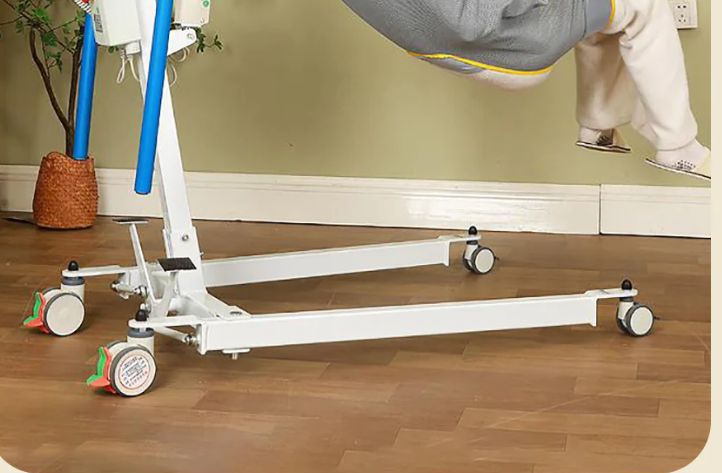
Extend the Hoyer Lift’s legs and confirm they are fully locked (this is the most easily overlooked yet critical step in solo operation).
Select an appropriate sling and check its integrity.
Clear the path to ensure there is enough space to move around the bed.
Step 2: Apply the Sling Alone
For patients who can provide slight cooperation, guide them to lie on their side, and the caregiver quickly slides the folded sling under their back.
For patients who cannot cooperate at all, use the "rolling method": stand on the patient’s uninjured side, place one hand on their shoulder and the other on their hip, gently roll them onto their side, insert the sling, then lay them flat again. Move steadily throughout the process to avoid dragging the patient’s skin.
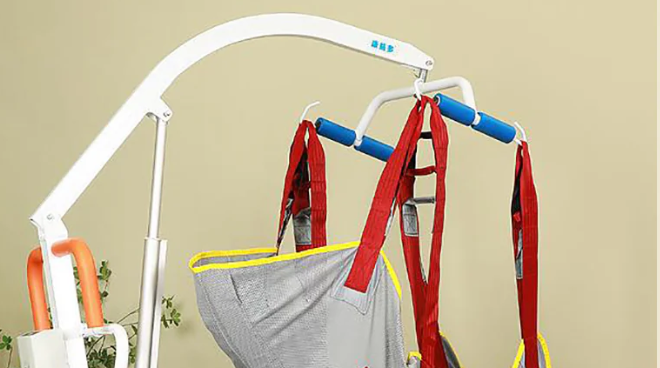
Step 3: Attach the Hooks and Perform a Low-Altitude Test
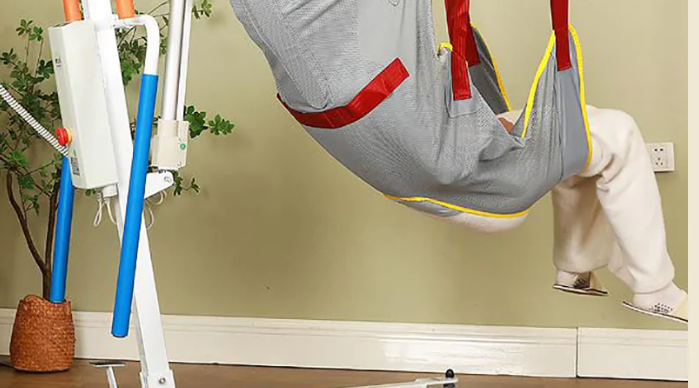
During solo operation, it is even more necessary to rely on low-altitude testing to "compensate" for the observational role of a second person. hoyer lift one person assist After lifting the patient by 5–10 centimeters, pause for a few seconds and visually check:
Is the sling properly aligned?
Is the patient slipping?
Is the equipment tilting?
If any abnormalities are found, lower the patient immediately and readjust.
Step 4: Focus on Operation and Maintain Communication
Use the remote control to lift the patient slowly to an appropriate height. When moving the equipment, keep your center of gravity low and hold the lifting arm with both hands (rather than just pushing the base) to enhance control.
Maintain verbal communication with the patient throughout: "We’re going to the bathroom now, don’t worry." This not only calms the patient but also helps the caregiver assess their condition through their responses.
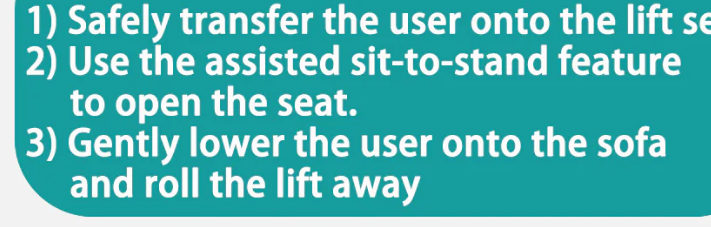
Step 5: Do Not Slack Off During Lowering and Follow-Up
After aligning with the target location, step firmly on the brakes before controlling the lift to lower.
Once the patient is seated securely, carefully remove the sling (assisting them to roll onto their side again if necessary).
Finally, adjust the patient’s clothing, ask about their comfort, and return the equipment to its storage location for charging.
III. High-Risk Scenarios for Solo Operation (to Be Avoided)
The patient’s weight exceeds 136 kg (300 lbs): Even if the equipment can support this weight, the large inertia and high center of gravity make it difficult for one person to handle sudden shifts.
The transfer path requires sharp turns or crossing thresholds: It is hard for one person to simultaneously control the direction and monitor the patient.
The patient has a recent history of falls or osteoporosis: hoyer lift one person assist Any minor mistake may lead to fractures.
The caregiver has a back injury or insufficient physical strength: Forced operation may cause secondary injuries.
In these cases, be sure to seek assistance from others or consider installing a ceiling-mounted track lift system—which is truly the ultimate solution designed for frequent solo operation.
IV. Practical Tips to Improve the Safety of Solo Operation
Use an electric model with "slow lift and slow lower" functions: Avoid startling the patient with sudden starts or stops.
Stick positioning marks beside the bed and at target locations: Facilitate quick alignment and reduce repeated adjustments.
Wear non-slip gloves: Enhance grip, especially when hands are sweaty or the environment is humid.
Establish a "safety password": For example, "I’m going to lift now—are you ready?" to ensure the patient is mentally prepared.
Conduct regular simulation drills: Practice no-load operation alone when family members are not present to familiarize yourself with the equipment’s response.
V. Legal and Ethical Reminders
In professional nursing institutions, if policies stipulate that "high-risk transfers require two-person operation," caregivers must not violate the rules without authorization—even if the equipment supports solo use. hoyer lift one person assist This not only protects the patient but also shields the caregiver from professional liability claims.
In home environments, while there are no mandatory regulations for adult children or spouses, safety should still be the top priority. The few minutes saved are not worth a lifetime of regret.
Conclusion: Solo Operation Is Progress in Tools, Not a Reduction in Responsibility
The fact that Hoyer Lifts support solo operation is a reflection of technology’s consideration for human needs: it makes home care for elderly people living alone possible and gives tired nursing staff a moment of respite. However, this "convenience" must be built on rigor, training, and respect for safety protocols.
True professionalism lies not in saying "I can handle this alone," but in knowing "when I cannot handle this alone."
Before pressing the lift button each time, ask yourself:Is the equipment ready? Is the environment safe? Can they really cooperate? Am I truly ready?
For the destination of a safe transfer is never just a wheelchair or a toilet—it is mutual safety and intact dignity.