Category: Patient Lifts
Posted by 2026-01-07 10:01
hoyer lift pad placement

Hoyer Lift Sling (Pad) Placement Guide: Proper Application is Key to Safe Transfer
When using a Hoyer Lift to transfer patients, many people focus on equipment operation, outrigger locking, or lift control, but overlook a critical factor that determines success or failure—the sling. The sling, sometimes referred to as a "Lift Pad," is the only component that directly contacts and supports the patient’s body. Its correct positioning and proper application directly affect the safety and comfort of the transfer process, hoyer lift pad placement and may even impact the patient’s neurological function and skin integrity.
This article will detail the correct placement method for Hoyer Lift slings, covering key points for applying different types of slings, common mistakes and their consequences, and practical tips to help caregivers truly achieve "stable support, safe lifting, and respectful transfer."
I. Why is Sling Placement So Important?
A sling is not just a "piece of cloth," but a mechanical support system. It scientifically distributes pressure to evenly transfer the patient’s weight to the lift. Improper placement may lead to the following risks:
Slippage or tipping: Causing the patient to fall mid-air.
Local pressure: For example, constricting the popliteal fossa (behind the knee) and compressing the common peroneal nerve, leading to foot drop—a potentially permanent nerve injury.
Skin tears: Especially for elderly or malnourished patients, friction or shear force can cause severe pressure injuries.
Discomfort and resistance: Incorrect sling positioning makes patients feel pain or instability, increasing anxiety and struggle.
Therefore, correct sling placement is not a "close enough" task, but a precise operational step that must be executed accurately.
II. General Placement Principles: Applicable to Most Full-Body Slings
Regardless of the brand or model used, the following principles generally apply:
The buttocks must fully fit into the bottom pocket of the slingThis is the core weight-bearing area. If the buttocks are suspended or only partially in contact, the weight will shift to the thighs or waist, causing slipping or discomfort. The ideal state is: when the patient lies flat, the bottom of the sling naturally fits under the ischial tuberosities, forming a "U"-shaped support.
Leg straps should be positioned at the mid-thigh, never at the popliteal fossaLeg straps function to prevent the patient from sliding forward, but they must be placed around the mid-thigh (approximately 10–15 cm from the knee). Constricting the area behind the knee not only compresses nerves and blood vessels but may also cause excessive flexion of the knee joint during lifting, leading to pain or injury.
The back of the sling should be flat without wrinkles, and shoulder straps (if present) should be symmetricalThe back of the sling should lie flat on both sides of the patient’s spine, hoyer lift pad placement without twisting or folding. Shoulder straps (if equipped) must pass symmetrically under the armpits, without compressing the axillary nerves. The tightness should allow two fingers to be inserted between the strap and the body.
Ensure the sling is not twisted, and lifting loops face upwardBefore connection, check if the sling is knotted or reversed. All lifting loops must face upward and outward to facilitate proper attachment to the lift arm hooks.
III. Placement Key Points for Different Types of Slings
Standard Full-Body Sling
The most commonly used type, suitable for bed-to-chair transfers.
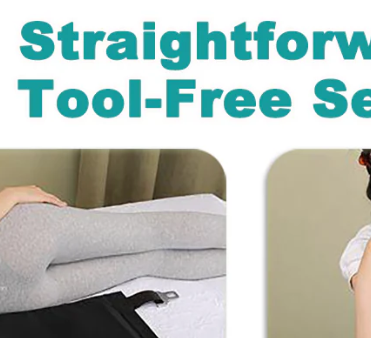
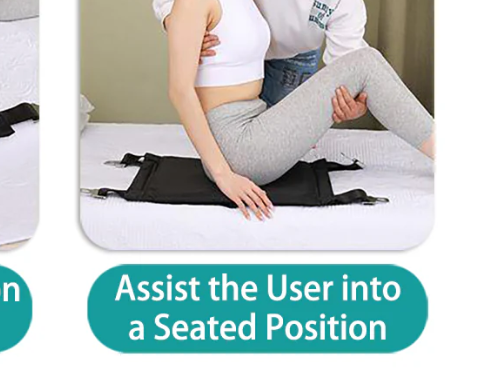
Use the "rolling method" for placement: Assist the patient to lie on their side, slide the folded sling under their back, then adjust it to a flat position.
Ensure the end of the sling supports the entire buttocks, and leg straps are placed around both thighs respectively.
Toileting Sling
Features an opening in the center of the crotch for easy toilet use.
During placement, pay special attention to aligning the opening with the perineum to avoid fabric pressing on sensitive areas.
After lifting, the patient can sit directly on the toilet without removing the sling.
Mesh/Hygiene Sling
Made of breathable, quick-drying material, designed specifically for showering or cleaning.
Due to the slippery texture of the material, it is even more important to ensure the buttocks fully fit into the bottom pocket to prevent slipping during bathing.
Rinse and dry thoroughly after use to avoid mildew.
Bariatric Sling
Wider in width and higher in weight capacity.
Requires more assistance during placement to ensure the patient’s body is centered, preventing uneven force distribution caused by leaning to one side.
IV. Sling Placement Tips for Single-Caregiver Operation
If only one caregiver is available, follow these steps:
Prepare in advance: Fold the sling into an "envelope shape" (fold the back in half, tuck in the leg straps) for easy and quick insertion.
Guide cooperation: If the patient is conscious, ask them to slightly bend their knees or lift their buttocks to create space for insertion.
Assist with rolling: Stand on the patient’s unaffected side, place one hand on their shoulder and the other on their hip, gently roll them to the side, and quickly insert the sling.
Adjust to flat position: After the patient lies flat, pull the end of the sling from the leg area, hoyer lift pad placement adjust its position, and ensure the buttocks are fully supported by the bottom pocket.
Tip: Pre-lay a smooth piece of fabric (e.g., an old bedsheet) under the patient’s bedsheet to reduce friction and facilitate sliding the sling into place.
V. Common Mistakes and Correction Methods
Mistake 1: Sling is only placed under the waist, with buttocks suspended→ Correction: Pull the sling down to under the buttocks to ensure the ischial tuberosities are supported.
Mistake 2: Leg straps are crossed or placed around the lower legs→ Correction: Separate the patient’s legs, place each leg strap around the mid-thigh, and keep them parallel.
Mistake 3: The back of the sling is piled up at the scapula area→ Correction: Spread the back of the sling flat; if necessary, ask the patient to slightly lift their back to smooth out wrinkles.
Mistake 4: Using a damaged or damp sling→ Correction: Check the sling’s integrity before each use. Damp slings have reduced strength and are strictly prohibited from use.
VI. Humanistic Care: Communication and Respect During Placement
Sling placement often requires exposing the patient’s body, which may easily cause shame or anxiety. Caregivers should:
Explain each step in advance: "I will help you put on the transfer sling; it may feel a bit cool, please relax."
Use privacy curtains or bedsheets to cover areas not involved in the operation.
Move gently to avoid dragging the patient’s skin.
Arrange the patient’s clothing after completion and ask about their comfort level.
Safe transfer is not just a technical task, but a process of building trust.
Conclusion: Professionalism Lies in the Details
Every smooth lift of a Hoyer Lift starts with the precise placement of the sling in those few seconds. hoyer lift pad placement The seemingly simple actions of "sliding in and strapping on" are backed by a comprehensive understanding of ergonomics, neuroanatomy, and care ethics.
Remember: No matter how advanced the equipment is, it cannot compensate for an incorrectly positioned sling. Only by internalizing standards into habits and treating details as responsibilities can we truly fulfill the care commitment of "safety, comfort, and dignity."
Because what supports a person is never just a machine, but the care that takes every detail seriously.
If you need it, I can help you organize a simplified Hoyer Lift Sling Placement Checklist (in English) that condenses the core points of this guide, making it easier for caregivers to quickly review and follow during actual operations. Do you want this checklist?