Category: Patient Lifts
Posted by 2026-01-08 10:01
hoyer lift slings
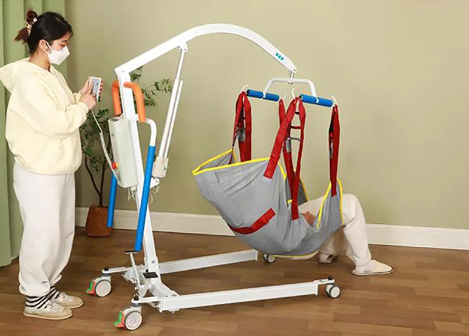
Complete Guide to Hoyer Lift Slings: The Ultimate Resource for Safety, Comfort, and Proper Selection
In a Hoyer lift system, the most core and personalized component is undoubtedly the sling. It acts as the "arms" that directly support the user, delivering stability and safety. Choosing the right sling is not only about comfort—it is the first line of defense for protecting lives.
If you are learning about "hoyer lift slings," this article will take you on a deep dive into sling types, selection methods, safety guidelines, and maintenance knowledge, ensuring you make the most informed choice for your loved one.
Why Are Slings So Important?
A sling is far more than just a piece of fabric. It is a precision-engineered medical device, with core functions including:
Safe Weight-Bearing: Distributes body weight evenly to prevent falls.
Comfortable Support: Provides support for the back, hips, and legs to avoid discomfort and pain.
Posture Maintenance: Helps the user maintain a correct and comfortable position.
Injury Prevention: An inappropriate sling can cause skin abrasions, pressure sores, or even poor blood circulation.
Common Sling Types and Their Applicable Scenarios
Slings are not "one-size-fits-all." Based on the user’s physical condition and mobility needs, they are mainly categorized into the following types:
1. Full-Back Slings
Description: Slings that offer comprehensive support from the back to the thighs, usually with multiple attachment points.
Suitable Users:
Individuals with extremely weak core strength who cannot sit up independently.
Those with poor trunk control.
Users who require maximum sense of security and support.
Advantages: Best support and strongest sense of security.
Disadvantages: Relatively cumbersome to put on; large contact area with the body.
2. Leg-and-Back Slings
Description: The most common universal slings, supporting the back of the thighs and knees.
Suitable Users:
Individuals with a certain ability to maintain sitting balance.
Those needing transfers to the toilet (as the hip area is open).
Advantages: High versatility; convenient for toilet use; relatively easy to put on.
Disadvantages: Provide less support for the trunk.
3. Stand-Up Slings
Description: Designed to assist users in moving from a sitting to a standing position, with attachment points typically around the chest and hips.
Suitable Users:
Individuals with partial lower limb strength who can engage in standing training.
Those needing transfers to a standing position (e.g., for toilet use or preparation before walking).
Advantages: Promote mobility; convenient for specific transfer needs.
Disadvantages: Require the user to have a certain level of cognitive ability and cooperation.
4. Specialized Slings
This category also includes: shower slings (made of mesh, quick-drying material) and wheelchair-specific slings, which are designed for specific scenarios.
How to Choose the Right Sling? A 4-Step Process
Step 1: Confirm Compatibility (Most Critical!)
The sling must be compatible with your Hoyer lift’s brand and model! Hook designs and attachment mechanisms vary across brands. Refer to your lift’s manual or the nameplate on the unit to ensure the sling you purchase is clearly labeled as compatible with your equipment.
Step 2: Determine the Correct Size
Sling size is not determined by the user’s height, but by key body measurements such as hip width and/or back length.hoyer lift slings Always use the size measurement guide provided by the supplier. A sling that is too small will cause discomfort from tightness; a sling that is too large will lead to poor posture and risk of slipping.
Step 3: Evaluate the User’s Physical Condition
Joint Mobility: Does the user have joint contractures? A sling with a special angle may be required.
Skin Condition: Is there a risk of pressure sores? Choose soft, seamless, and breathable fabrics.
Cognitive Status: Does the user experience anxiety? A full-back sling may provide a better sense of enclosure and security.
Step 4: Clarify the Transfer Purpose
Daily Bed-to-Chair Transfers: A leg-and-back sling is usually a good choice.
Toilet Use: Must choose a leg-and-back sling with an open crotch design or a specialized toilet sling.
Rehabilitation Training: Consider a stand-up sling.
Safe Usage and Daily Maintenance
Must-Check Before Each Use
Wear and Tear: Carefully inspect for tears, fraying, thinning, or discolored areas.
Stitches: Check that all stitches are secure.
Buckles and Attachment Points: Ensure there are no cracks, deformation, or rust.
Proper Application
Never let the sling come into direct contact with the skin; use it over clothing to reduce friction.
Ensure the sling is smooth and wrinkle-free, with all labels facing outward to avoid skin irritation.
Cleaning and Storage
Follow the manufacturer’s cleaning instructions. Most slings are machine-washable, but require mild detergent and low-temperature drying or air-drying.
Never use fabric softener—it can damage the fabric’s breathability and strength.
Store in a dry, cool place; avoid prolonged exposure to direct sunlight.
Important Warning: Any worn sling must be immediately taken out of use and replaced! Do not take risks.
Conclusion
Slings are silent yet crucial partners in the care process. Investing time to understand their types, take accurate measurements, hoyer lift slings and strictly follow safety guidelines is the highest commitment to the user’s dignity and safety. When you choose a perfectly fitting sling for your loved one, you are not only providing a safe transfer—you are delivering peace of mind and comfort. When in doubt, be sure to consult an occupational therapist or professional medical equipment supplier, who can provide you with the most professional on-site assessment and guidance.