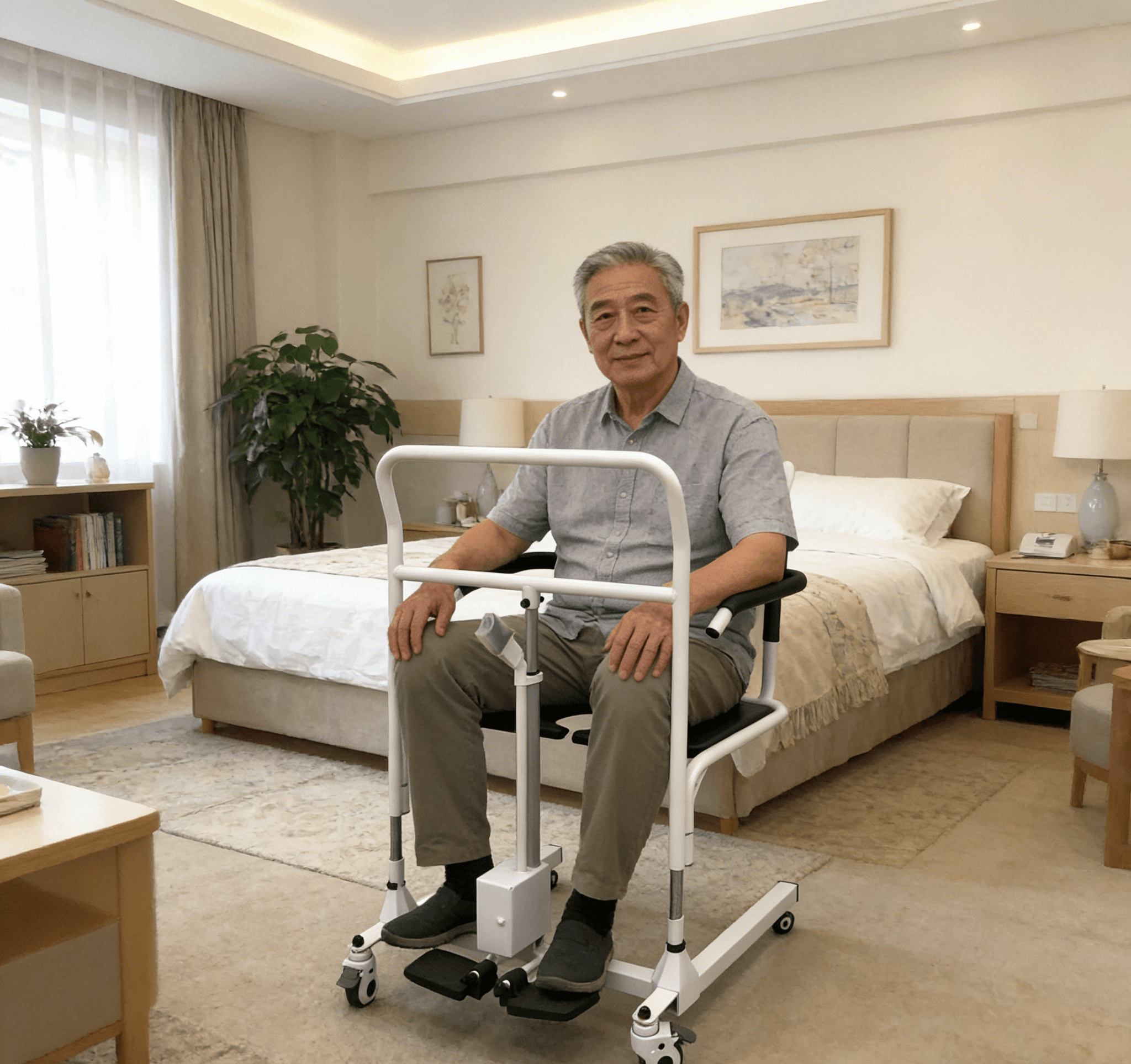
Category: Electric Transfer Chair
Posted by 2025-12-13 11:12
hoyer lift attached to bed
Can a Hoyer Lift Be "Installed Beside the Bed" Directly? Clarifying Misconceptions and Finding Truly Home-Suitable Solutions
Many family caregivers who use a Hoyer Lift naturally have a thought: "It would be great if the lift could be fixed directly beside the bed—this way, there’s no need to move it around every time, saving space and making it more convenient." As a result, "Hoyer lift attached to bed" has become a common search term.
However, standard floor-standing Hoyer Lifts (whether manual or electric) cannot and should not be directly "installed" or "fixed" to a hospital bed. Forced modification not only violates safety regulations but may also cause the equipment to tip over, structural breakage, or even severe injuries.
This article will clarify this common misconception and introduce professional solutions that truly enable "bedside-integrated transfers," helping you improve care efficiency while ensuring safety.
I. Why Can’t Standard Hoyer Lifts Be "Installed Beside the Bed"?
1. Structural Design Does Not Support Fixation
Floor-standing Hoyer Lifts rely on a wide base and low center of gravity for stability;
Tying or securing the lift to the bed frame will disrupt its original mechanical balance, making it highly prone to tipping during lifting or lowering;
The bed itself is not a load-bearing structure and cannot withstand the dynamic loads (which can exceed 200 kg) generated during transfers.
2. Mobility Is Its Core Advantage
The value of a Hoyer Lift lies in its flexibility to move between the bed, wheelchair, toilet, and bathroom;
Fixing it beside the bed would instead eliminate this function, going against its original design purpose.
3. Extremely High Safety Risks
There have been cases where families used ropes or chains to tie the lift to bed legs. During a transfer, the bed legs broke, causing the patient to fall;
Medical equipment safety standards (such as ISO 10535) explicitly prohibit non-original modifications to Hoyer Lifts.
✅ Conclusion: Do not attempt to "fix" a standard Hoyer Lift to the bedside using tape, ropes, bolts, or other means.
II. Truly Feasible "Bedside-Integrated" Solutions
If you want to achieve "transfers without moving the equipment," the following two types of professional systems are the correct choices:
Solution 1: Ceiling Track Lift System
This is the mainstream solution in hospitals and high-end elderly care facilities, and it is gradually being adopted in homes.
Principle: Aluminum alloy tracks are installed on the room’s ceiling, and an electric lift slides along the tracks;
Advantages:
Takes up no floor space at all;
Can cover multiple areas including the bed, wheelchair, and bathroom;
Operates quietly, allowing a single caregiver to complete transfers;
Applicable Scenarios:
Patients who are bedridden long-term or fully immobile;
Home care with high intensity (multiple transfers per day);
Homes with structures that allow installation (requires load-bearing ceilings or reinforcement);
Representative Brands: Handicare, Guldmann, SureHands.