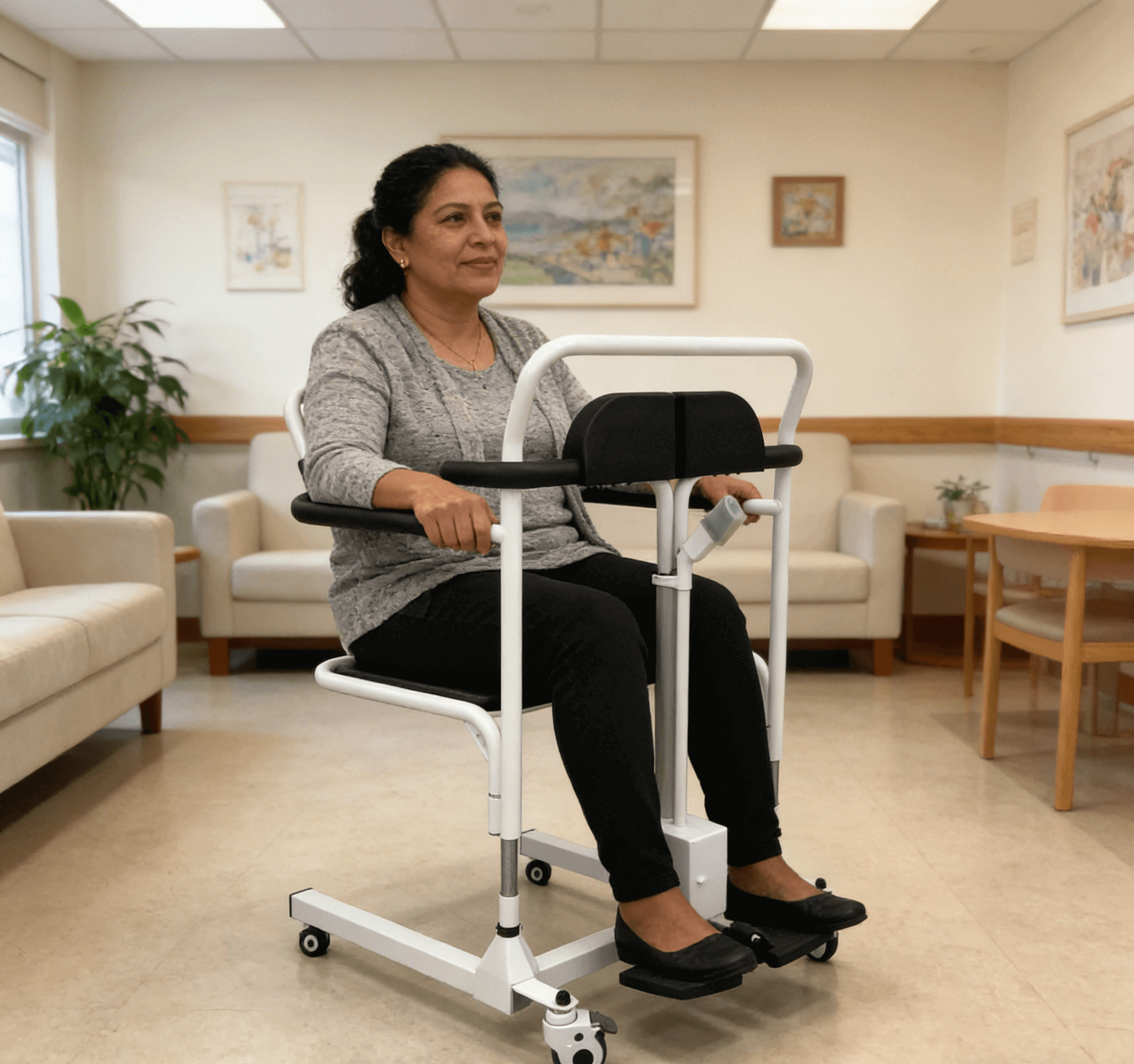
Category: Electric Transfer Chair
Posted by 2025-12-24 11:12
hoyer lift for stairs
Hoyer Lifts and Stair Transfers: Understanding Risks and Exploring the Only Safe Solutions
A common and urgent question arises: "Can a Hoyer Lift be used to safely move a person with limited mobility up or down stairs?"
The short and definitive answer is: Absolutely not. Attempting to use a standard floor-based Hoyer Lift for stair transfers is extremely dangerous and can lead to severe, even fatal, accidents.
This article will explain why this practice is strictly prohibited and outline the truly safe and reliable solutions when faced with stair-related obstacles.
I. Why Standard Hoyer Lifts Are Strictly Forbidden on Stairs
Standard Hoyer Lifts are designed only for use on solid, flat, level ground. Using them on stairs poses the following catastrophic risks:
Risk of Tipping
The lift’s base is engineered to maintain stability on flat surfaces. When its wheels or legs are positioned on steps of different heights, hoyer lift for stairs the center of gravity shifts instantly—causing the entire device (along with the user) to tip backward or forward.
Equipment Failure
The lift’s structure, hydraulic, or electric systems cannot withstand the uneven pressure generated on sloped angles and varying steps. This can lead to component damage or sudden malfunction.
Danger to Caregivers
To control a potentially tipping lift, caregivers often stand below or beside it—putting them at significant risk of being crushed by the falling equipment. Caregivers also face a high chance of losing their balance and falling themselves.
Danger to Users
In the event of tipping or slipping, the user may become trapped under the equipment or fall from a height—resulting in severe injuries such as fractures or traumatic brain injuries.
Core Principle: Any "trick" or "method" claiming to make Hoyer Lifts usable on stairs is irresponsible and life-threatening. Such practices must be avoided entirely.
II. Safe Solutions for Overcoming Stair Obstacles
Since standard lifts are not feasible, what are the safe options when a user needs to move between floors?
1. Stair Lifts
Description: A single-person chair that runs along a track installed on stairs. It moves smoothly up and down the track via a remote control or a controller on the chair itself.
Advantages:
High safety: Specifically designed for stairs, equipped with safety belts and multiple safety sensors.
Independence: Users can operate it independently without assistance to move between floors.
Wide applicability: Can be installed on straight stairs, curved stairs, and even spiral stairs.
Considerations: Requires a professional assessment for installation. Users need basic sitting balance and cognitive ability to operate it.
2. Vertical Platform Lifts
Description: Similar to a small accessibility elevator, this is a vertical platform that operates within or alongside a stairwell. hoyer lift for stairs It can accommodate one user and a wheelchair.
Advantages:
Solution for wheelchair users: Users can move between floors without leaving their wheelchairs.
Extreme stability and safety: The platform runs within enclosed tracks or a shaft, offering the highest level of safety.
Considerations: Has higher installation requirements, needs sufficient space and structural support, and is relatively costly.
3. Home Elevators
Description: The most advanced solution, featuring a full cabin that travels between floors.
Advantages: Provides maximum convenience, comfort, and safety. Can accommodate multiple people and a wheelchair.
Considerations: Highest cost option, requiring extensive home renovations.
4. Planning Single-Floor Living
Description: The most cost-effective solution. Restructure the main living areas (bedroom, bathroom, kitchen) to be on the ground floor of the home.
Advantages: Eliminates the need to use stairs entirely, with no equipment installation costs.
Considerations: May require minor home renovations.
5. Professional Transfer Services
Description: For non-emergency medical trips (e.g., hospital follow-up appointments), contact professional non-emergency medical transportation services. hoyer lift for stairs These teams are specially trained and equipped with appropriate tools (such as tracked stair chairs) to safely move people with limited mobility up and down stairs.
Advantages: Addresses temporary, occasional mobility needs.
Considerations: Intended for special circumstances, not as a daily solution.
III. What If You Need to Move the Hoyer Lift Itself Between Floors?
Sometimes, you may need to transport the Hoyer Lift itself from the ground floor to an upper floor (not to move a person).
Solutions:
Full Disassembly: Take the lift apart into its main components (base, column, boom) according to the instruction manual.
Separate Transport: Have two capable people carry each component upstairs separately, then reassemble the lift at the destination.
Seek Help: Do not take risks if components are too heavy—ask for assistance.
IV. Summary of Key Safety Warnings
Never use any type of floor-based Hoyer Lift to move people up or down stairs.
Never attempt to "test" or "jam" the lift’s front wheels on steps.
Any accessory or technique claiming to make Hoyer Lifts usable on stairs should be regarded as dangerous.
Conclusion
When facing stairs—the main obstacle in a home environment—the correct approach is to recognize the limitations of standard Hoyer Lifts and switch to solutions specifically designed to overcome this barrier. Investing in a stair lift or vertical platform lift is a responsible choice for the user’s safety and the caregiver’s physical and mental well-being. In caregiving, safety always comes first—no shortcut is worth risking a life.