Category: Patient Lifts
Posted by 2026-01-09 13:01
hoyer lift training for nurses

Beyond Basic Operation: Why Hoyer Lift Training Is an Indispensable Professional Skill and Safety Barrier for Nurses
In clinical nursing, patient transfer is one of the most frequent, physically demanding, and injury-prone tasks. As a key assistive device, the use of a Hoyer lift goes far beyond the simple steps of "hooking, lifting, and moving." For nurses, comprehensive Hoyer lift training has transcended basic skill requirements—it serves as a solid cornerstone for patient safety, occupational self-protection, legal compliance, and high-quality care.
If you are interested in "hoyer lift training for nurses," this article will delve into the core content of professional training, its importance, and how to translate it into excellent clinical practice.
I. Why Is Basic Knowledge Far from Sufficient? The In-depth Value of Nurse Training
1. Patient Safety Risk Assessor
Nurses need to determine not just "whether a Hoyer lift can be used," but rather "for this patient’s current condition, which type of lift, which type of sling, and which operation method are the safest and most comfortable?" This requires a comprehensive physical assessment of the patient.
2. Occupational Protection for Caregivers Themselves
Nurses are a high-risk group for low back injuries. Proper Hoyer lift operation is the most effective way to prevent occupational musculoskeletal disorders, especially low back injuries. Training not only protects patients but also safeguards the nurse’s professional career.
3. Institutional Compliance and Risk Management
Adhering to standardized operating procedures is critical for healthcare facility accreditation and responding to legal disputes. Formal training ensures that operations comply with occupational safety regulations (such as those from OSHA) and nursing practice standards.
II. Core Curriculum Content of Professional Hoyer Lift Training
An excellent training program should include the following modules:
1. Assessment and Decision-Making
Patient Assessment: Evaluate the patient’s weight, cognitive level (cooperation/anxiety), physical mobility (presence of joint contractures), skin condition (presence of pressure sores), pain level, and the presence of drainage tubes or IV lines.
Equipment Selection: Based on assessment results, select the appropriate lift type (manual/electric), sling type (full-back/leg-and-back/stand-up), and size.
Environmental Assessment: Check if the ward has sufficient space, hoyer lift training for nurses if bed/chair heights are adjustable, and if the floor is flat and obstacle-free.
2. Equipment Proficiency and Safety Inspection
Mechanical Principles: Understand the basic principles of hydraulic and electric equipment, and be able to anticipate potential failures (e.g., slipping, oil leakage).
Pre-use Inspection Checklist (Daily/Per-use):
Sling: Conduct a 6-point inspection (check for wear, tears, loose stitching, discoloration, deformed buckles, and damaged lifting loops).
Lift Unit: Inspect outrigger latches, hydraulic functions, battery level (for electric models), and casters.
Emergency Failure Response: Learn emergency procedures for safely lowering the patient if the equipment malfunctions suddenly.
3. People-Centered Operation Techniques and Communication
Psychological Comfort Techniques: For conscious patients, especially first-time users, explaining the process and gaining trust are crucial. Training should include communication scripts.
Team Collaboration: Clarify role division during two-person operations (one person operates the equipment, the other stabilizes the patient, observes, and communicates). Practice unified verbal cues.
Refined Operation:
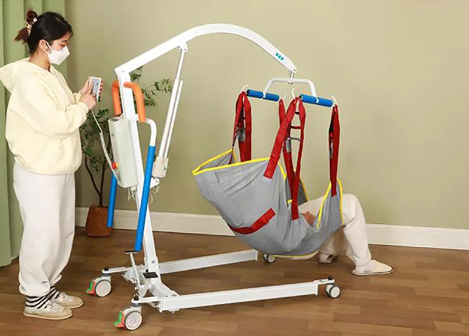
How to slide the sling flat under the patient without causing discomfort or skin shear.
How to balance the sling to ensure the patient maintains a comfortable, ergonomic position mid-air.
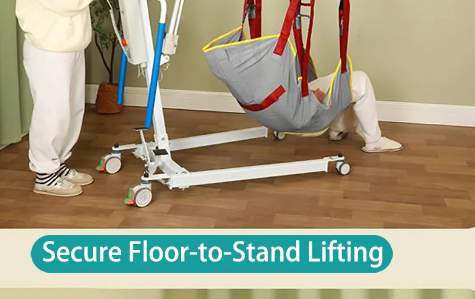
How to achieve seamless transfers between bed, chair, and toilet.
4. Infection Control and Equipment Cleaning
Learn how to properly clean and disinfect the lift and sling under different isolation requirements (e.g., contact isolation) to prevent cross-infection.
III. From "Knowing" to "Doing": Effective Training Models
Theory + Intensive Hands-on Practice: Training must include practical, hands-on operation in real or simulated ward environments, using different models of equipment for practice.
Scenario Simulation Training: Set up complex scenarios (e.g., transferring a highly uncooperative dementia patient, hoyer lift training for nurses a bariatric patient, or a patient with multiple tubes) to develop nurses’ clinical judgment and problem-solving abilities.
Competency Certification and Regular Refresher Training: Operational qualification should not be a one-time achievement. An annual or biennial refresher training and assessment system should be established to consolidate skills and update knowledge.
IV. Return on Investment in Training: Invisible yet Significant Benefits
Comprehensive hoyer lift training for nurses yields immediate and far-reaching returns:
Significant Reduction: In patient falls, skin injuries, and equipment-related adverse events.
Significant Decrease: In nurse work-related musculoskeletal injuries and sick leave.
Comprehensive Improvement: In patient satisfaction, nurse job confidence, and team collaboration efficiency.
Effective Avoidance: Of medical disputes and legal risks caused by improper operation.
Conclusion
For modern nurses, Hoyer lift operation is not a simple physical task, but a comprehensive nursing skill that integrates clinical assessment, decision-making, interpersonal communication, mechanical knowledge, and team collaboration. Investing in comprehensive, in-depth, and ongoing Hoyer lift training is far more than a cost—it is a cost-effective strategic investment in patient safety, nurse well-being, and healthcare quality. It transforms nurses from physical laborers into professional caregivers who safeguard safety with wisdom and skills.